Hearing With One Ear in Noisy Places: Why It's Hard and What Helps.
Published
Why does a restaurant dinner leave you more drained than a full workday? With one hearing ear, your brain works overtime in noise. Here's why, and what helps.
If you hear with only one ear, you probably know how it goes. A quiet chat at home goes fine. But sit down in a busy restaurant, and the person across the table might as well be whispering. You catch half a sentence, you guess the rest, and nod along. By dessert, you're worn out.
Why does this happen? Yes, we have two ears for redundancy (two is better than one). But another major reason to have two ears is that our brains are built to compare sounds coming from different ears. When one of them stops contributing, you lose several specific advantages at once. And in noisy rooms it gets worse.
This article explains what two ears do together and what changes with single-sided deafness (SSD). Thankfully, there are some practical steps that make noisy places easier.
How two ears handle a noisy room
With two working ears, your brain gets two slightly different versions of every sound. A voice on your left reaches your left ear a fraction of a millisecond earlier, and a little louder, than your right ear 1. Your brain uses those differences in four ways, each explained in more detail in How Your Ears Pull Voices Out of Noise:
- Binaural summation. When both ears hear the same sound, the brain combines the two signals, and the sound comes across louder and clearer 2,3. In a noisy room the benefit is modest, because the noise reaches both ears too.
- The head shadow effect. Your head blocks sound, especially high-pitched sound, so the ear facing away from a noise gets a cleaner mix of voice and noise. The brain listens to that better ear. This is the biggest two-ear advantage: in one classic study, it improved speech understanding by up to about 8 decibels when the noise came from the side 4.
- Binaural squelch. When the voice and the noise come from different directions, the brain lines up the noise in the two ears and largely cancels it, leaving more of the voice 4,5.
- Sound localization. Comparing the ears tells you where a voice is coming from, so you can turn to face the speaker, see their lips, and keep track of who is talking in a group 1.
The last three only work when the voice and the noise come from different directions, which in real rooms they usually do. All four depend on the brain comparing two ears, and that comparison is what single-sided deafness takes away.
What changes with single-sided deafness
With single-sided deafness, everything arrives through one channel, so the brain has nothing to compare. Even if your hearing ear tests as perfectly normal, all four advantages are lost or weakened, and one of them starts working against you.
Summation and squelch are gone
With one hearing ear, there is no second copy to average and no second signal to subtract. Research reviews put the combined benefit of these two-ear effects at roughly 2 to 6 decibels in listening tests 2.
That may sound small, but in a noisy room a few decibels is often the difference between following a conversation and catching only fragments of it.
The head shadow works against you
With two ears, the head shadow always leaves one ear with a better mix. With one ear, you no longer get to choose. You're stuck with whatever mix reaches your hearing ear.
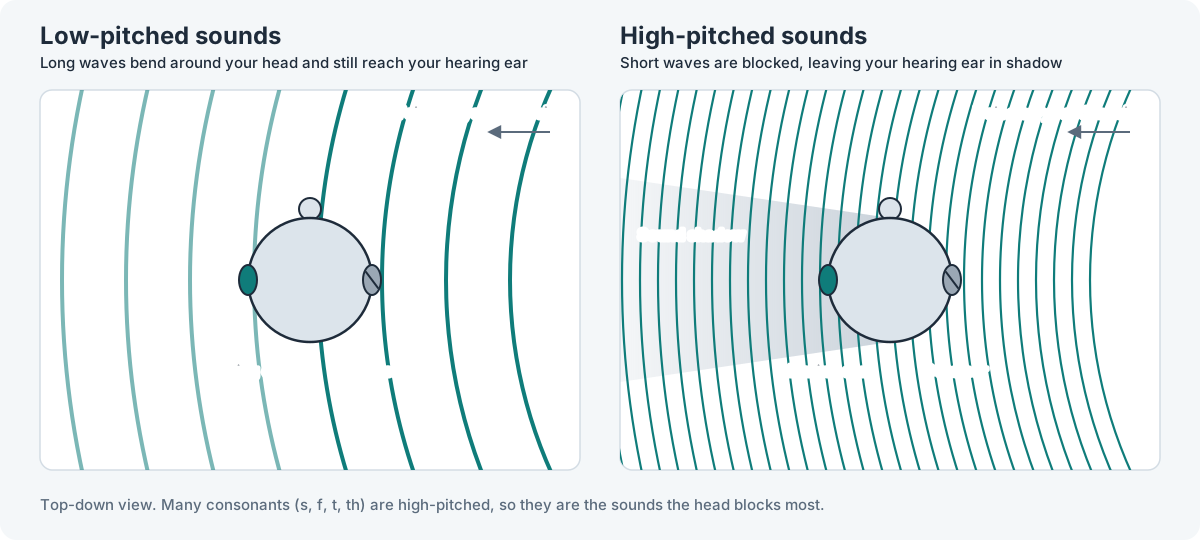
When someone talks on your deaf side, their voice has to travel around your head and arrives weaker. The shadow is strongest for high-pitched sounds, which have short wavelengths and are blocked more than low-pitched ones. Many consonants, such as s, f, t and th, are high-pitched, and consonants carry much of the meaning in speech. A voice from your deaf side may still seem present, just muffled, and words like "sixty" and "fifty" start to blur together.
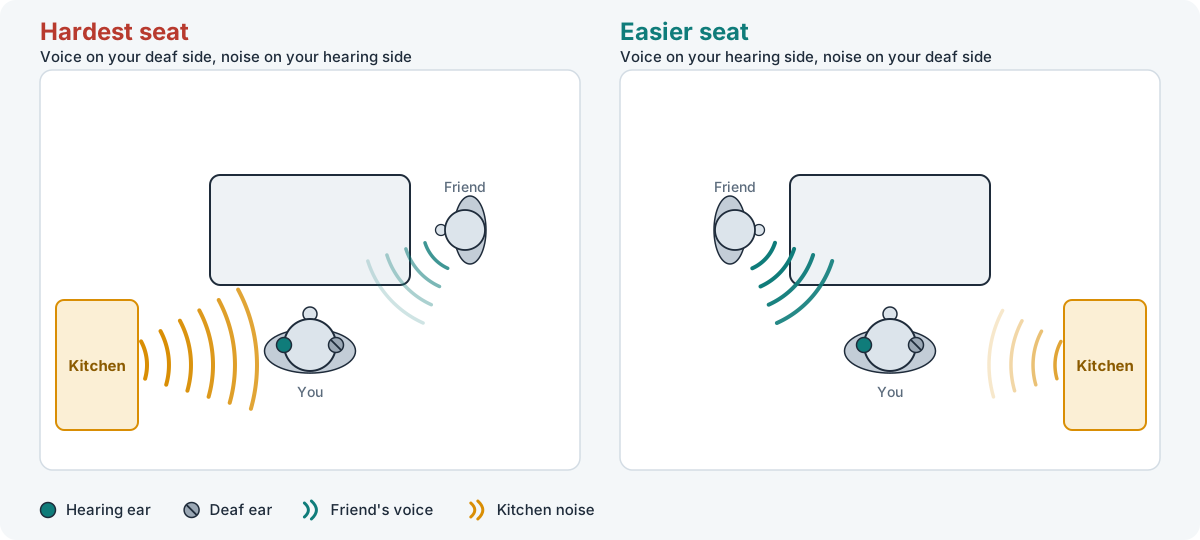
Now add noise. Suppose the person you're talking to is on your deaf side and the noisy kitchen is on your hearing side. Your good ear gets the noise at full strength and the voice at reduced strength. That's the worst possible arrangement, and it's why the same restaurant can feel fine from one seat and impossible from another.
There is a flip side. When the noise is on your deaf side, your head blocks it for you. Since head shadow is the largest of the two-ear effects 4, where you sit is one of the most powerful things you can control. The seating tips below are built on this.
Finding the speaker is harder
Without timing and loudness differences between the ears, working out where a sound comes from becomes much harder 6.
Some people with SSD develop partial workarounds. Because sounds from the deaf side come through quieter, the brain can use the volume of a familiar sound as a rough clue to its direction. It can also pick up subtle changes that the shape of the outer ear makes to incoming sound 1,6. These strategies help, but they're easily fooled. A soft voice on your hearing side and a loud voice on your deaf side can seem to come from the same place.
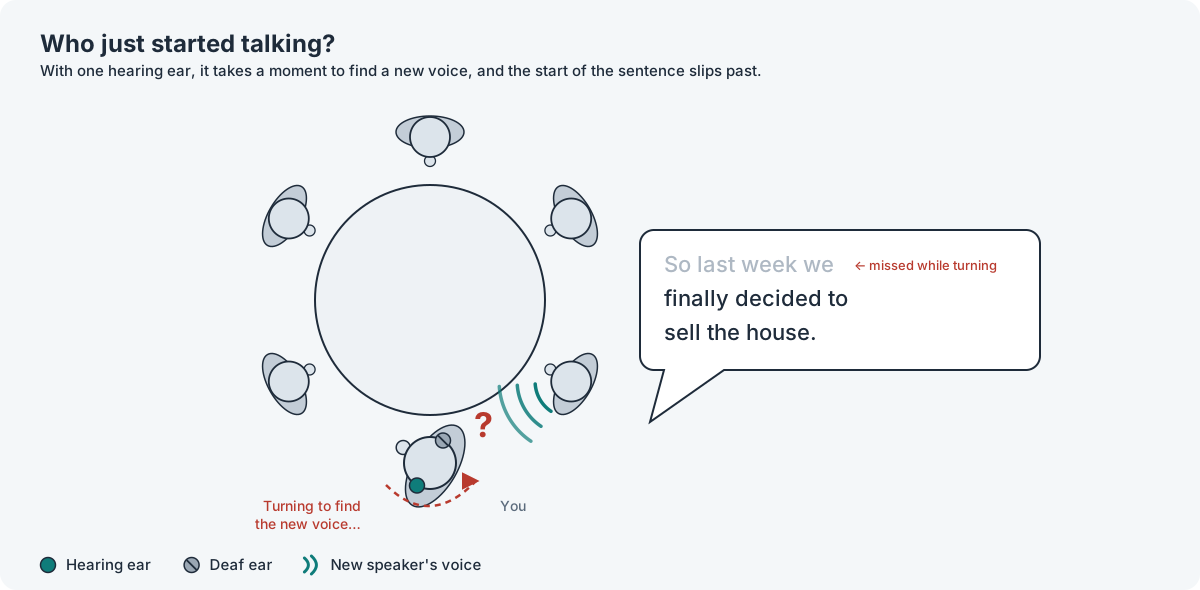
Group conversations get disorienting. When someone new starts talking, you need a moment to find them, and by the time you've turned your head you've missed the start of their sentence. Outdoors, not knowing where a car horn or siren is coming from can also be a safety concern.
Why noisy places are so tiring
When the signal is weaker and the brain's noise filter is gone, your brain has to make up the difference with extra work. It guesses missed words from context, watches lips, and holds half-heard sentences in memory until the meaning becomes clear. Researchers call this "listening effort".
That effort has been measured directly. It turns out that pupil size can be used as an indicator of mental effort. A 2025 study used changes in pupil size to measure effort during listening tasks, and people with SSD showed significantly higher effort than people with typical hearing 7. This may explain the extra strain and fatigue. Unsurprisingly, people with SSD also report more hearing-related fatigue in everyday life 2.
So if you leave a dinner party or any other gathering exhausted, there's a good reason for that.
What helps in noisy rooms
You can't change how your ears work, but you can change the listening situation. Some of this advice may seem obvious, but it can make a difference.
Choose your seat deliberately
- Put the people you want to hear on your hearing side, and the main source of noise on your deaf side. That way the head shadow works for you, blocking noise instead of speech.
- In restaurants, a corner or booth seat with your back to the wall cuts noise from behind and keeps your companions in front of you.
- At a long table, sit at one end with your deaf side toward the wall, so most of the group is on your hearing side.
- If you use a CROS aid, the seating advice changes, because the device brings deaf-side noise to your good ear as well. Many CROS users turn it down or switch programs in noisy places.
Manage the environment
- Choose quieter venues or quieter times, and ask for a table away from the kitchen, bar and speakers.
- Rooms with carpets, curtains and upholstered seating absorb echo. Hard, open-plan spaces are the most difficult.
- Good lighting lets you see faces and also helps with lip-reading.
Use communication tactics
- Tell people which side to talk to. Most are glad to help once they know.
- When you join a conversation partway through, ask what the topic is. Context makes missed words much easier to fill in.
- Ask people to rephrase rather than repeat, since different wording often gets through where the same words didn't.
- Plan short breaks during long events. A few minutes somewhere quiet can restore your energy for the next round.
Consider hearing devices
Several devices are designed specifically for single-sided deafness. CROS hearing aids send sound from a microphone on your deaf side to your hearing ear. Bone-anchored systems carry sound through the bone of the skull to the hearing ear. Cochlear implants give the deaf ear its own input. All three reduce the head shadow problem in different ways 2. Of the three, only a cochlear implant offers the potential to restore some two-ear hearing, but candidacy depends on your situation, and each option has trade-offs 2.
When to see an audiologist
If noisy places are wearing you down, an audiologist can measure how well you understand speech in noise, not just in a quiet test booth. They can also let you try devices before you commit to one. Regular checks of your hearing ear are worth keeping up too, since you now rely on it for everything.
If you notice a sudden drop in hearing in either ear, don't wait for a routine appointment. Sudden hearing loss should be checked by a doctor within days, not weeks, because some treatments work best when started early.
Sources
-
Van Wanrooij MM, Van Opstal AJ. Contribution of head shadow and pinna cues to chronic monaural sound localization. J Neurosci. 2004;24(17):4163–4171. doi:10.1523/JNEUROSCI.0048-04.2004
-
Swain SK. Single-sided deafness: a narrative review. Apollo Medicine. 2024;21(1 Suppl):S96–S100. doi:10.1177/09760016241274412
-
Avan P, Giraudet F, Büki B. Importance of binaural hearing. Audiol Neurootol. 2015;20(Suppl 1):3–6. doi:10.1159/000380741
-
Bronkhorst AW, Plomp R. The effect of head-induced interaural time and level differences on speech intelligibility in noise. J Acoust Soc Am. 1988;83(4):1508–1516. doi:10.1121/1.395906
-
Durlach NI. Equalization and cancellation theory of binaural masking-level differences. J Acoust Soc Am. 1963;35(8):1206–1218. doi:10.1121/1.1918675
-
Agterberg MJH, Hol MKS, Van Wanrooij MM, Van Opstal AJ, Snik AFM. Single-sided deafness and directional hearing: contribution of spectral cues and high-frequency hearing loss in the hearing ear. Front Neurosci. 2014;8:188. doi:10.3389/fnins.2014.00188
-
Su W, Xia Y, Xia C, Zhang Y, Zhang Y, Liu Y. Impact of single-side deafness on listening effort: a prospective comparative study. Laryngoscope Investig Otolaryngol. 2025;10(4):e70185. doi:10.1002/lio2.70185