How Your Ears Pull Voices Out of Noise
Published
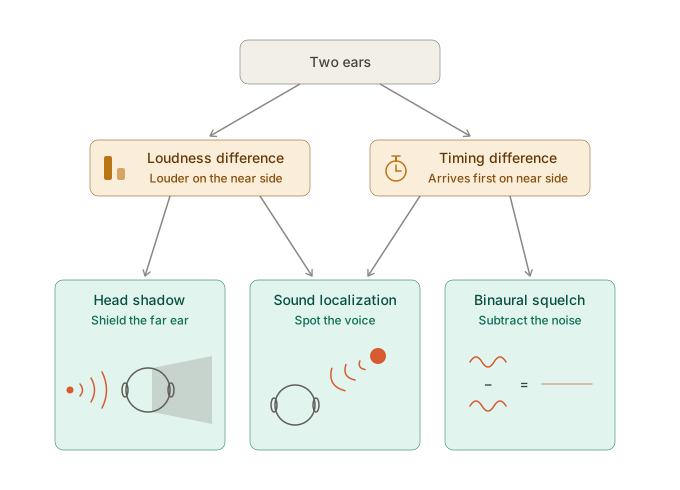
How do you follow one friend's voice in a busy restaurant? Your brain combines and compares what your two ears hear in four clever ways. Here's how each one works.
Picture a busy restaurant. Dishes clatter, music plays, and a dozen conversations overlap. Yet you can follow the friend across the table, mostly without thinking about it. Researchers call this the cocktail party effect, brought to you by having two ears.
Two ears aren't just a spare, although that's a benefit too. Your brain constantly combines and compares what each ear hears, using both the similarities and the differences to locate sounds and pull voices out of noise. Read on to learn about the ingenious ways we use two ears to achieve better hearing in noise.
Two ears, two versions of every sound
With two working ears, your brain gets two slightly different versions of every sound. How does that work? A voice on your left reaches your left ear a fraction of a millisecond before your right ear, and it's a little louder on that side 1,3. Sound travels through air at only about 1.1 feet per millisecond, so even the short extra trip around your head adds a delay your brain can measure.
The head shadow effect: one ear always gets a better mix
Your head is a solid object, and sound doesn't pass through it cleanly. For example, a sound coming from your left has to travel around your head to reach your right ear, so it arrives weaker there. Audiologists call this the head shadow effect, because your head casts an acoustic shadow much as it casts a shadow in sunlight 2.
The shadow is strongest for high-pitched sounds, which have short wavelengths and are blocked more than low-pitched ones. That matters because many consonants, such as s, f, t and th, are high-pitched, and consonants carry much of the meaning in speech.
With two ears, the shadow is an advantage. If noise comes from your left, your head shields your right ear from it, so the right ear hears the voice with less noise. Your brain simply pays more attention to whichever ear has the better mix. Researchers call this better-ear listening.
The effect is significant. In a classic study of listeners with typical hearing, moving the noise from in front to the side improved speech understanding by about 3.5 to 7.8 decibels from head shadow alone, depending on where the noise was 4. That usually makes it the biggest of the two-ear advantages.
Binaural squelch: the brain's noise canceller
Squelch is the brain's "active noise cancellation" mechanism. Like head shadow, it works only when the voice and the noise come from different directions.
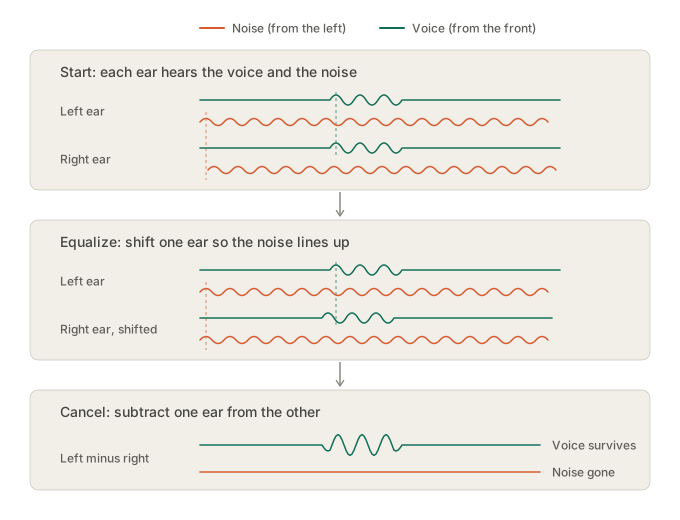
Each sound reaches your two ears with its own timing difference. Noise from your left, for example, arrives at your left ear a fraction of a millisecond early. What happens next is not entirely clear, but a leading theory, the equalization-cancellation model, suggests the brain then does something like this 5:
- Equalize: it shifts and re-scales one ear's signal so that the noise lines up exactly with the noise in the other ear.
- Cancel: it subtracts one ear's signal from the other, and the lined-up noise largely cancels out.
Recall that the voice comes from a different direction, so it has a different timing difference. It doesn't line up, and much of it survives the subtraction. The order matters: without lining up the noise first, the subtraction wouldn't remove the noise. Instead, it would cancel whatever already matches in both ears, such as a voice from straight ahead.
The brain's timing isn't perfect, so the cancellation is never total. It works best for lower-pitched sounds, where timing cues are strongest 4. In the same classic study, timing differences alone improved speech understanding by about 4 to 5 decibels 4. That figure comes from a controlled lab setup. In clinical tests, where squelch is measured as the benefit of adding the ear nearer the noise, the measured benefit is usually smaller.
The two effects don't simply add up, either. When the study combined timing and level differences, as happens in real life, the total improvement was up to about 10 decibels 4, less than the two separate figures added together.
Sound localization: knowing where to listen
Your brain uses the same timing and loudness differences to work out where a sound is coming from 1. Knowing where a voice is helps in a noisy room in several ways:
- You can turn and look. Facing the speaker lets you see their lips and expressions, which fill in sounds the noise covers up.
- You can focus on a place. Much of the noise in a busy room comes from everywhere at once, such as chatter and echoes, while the voice you want comes from one point. When the voice has a clear location, it stands out from that background, and the brain can follow it even when other people are talking.
- You can keep up in groups. When someone new starts talking, you find them almost instantly, so you don't miss the start of what they say.
In a quiet room, none of this matters much. In a noisy one, these advantages add up.
Binaural summation: a small boost from two copies
Of the two-ear advantages in noise, summation is the smallest. But unlike head shadow and squelch, it doesn't depend on the voice and the noise coming from different directions, so it still helps a little when they come from the same place.
When the same sound reaches both ears, the brain combines the two signals, and the result comes across louder and clearer than either one alone 2,3.
In a noisy room, the extra loudness doesn't help by itself. It applies to everything you hear, the noise as much as the voice, so the mix stays the same.
The useful part is clarity. Each ear's pathway to the brain adds a little random "static" of its own, because nerve cells don't fire with perfect precision. The static is different in each ear, but the sound itself is the same. When the brain combines the two copies, the sound adds up consistently while the random static partly evens out, much as two independent measurements, averaged, are more reliable than either one. That makes the voice slightly easier to pick out, even when both ears hear the same mix.
When the two-ear advantage is lost
All these advantages depend on the brain combining and comparing two working ears. Hearing loss in one or both ears can weaken them, and with single-sided deafness, where one ear doesn't hear at all, the brain has nothing to compare. To learn what that means in noisy places and what helps, read Hearing With One Ear in Noisy Places.
Quiz
Sources
-
Van Wanrooij MM, Van Opstal AJ. Contribution of head shadow and pinna cues to chronic monaural sound localization. J Neurosci. 2004;24(17):4163–4171. doi:10.1523/JNEUROSCI.0048-04.2004
-
Swain SK. Single-sided deafness: a narrative review. Apollo Medicine. 2024;21(1 Suppl):S96–S100. doi:10.1177/09760016241274412
-
Avan P, Giraudet F, Büki B. Importance of binaural hearing. Audiol Neurootol. 2015;20(Suppl 1):3–6. doi:10.1159/000380741
-
Bronkhorst AW, Plomp R. The effect of head-induced interaural time and level differences on speech intelligibility in noise. J Acoust Soc Am. 1988;83(4):1508–1516. doi:10.1121/1.395906
-
Durlach NI. Equalization and cancellation theory of binaural masking-level differences. J Acoust Soc Am. 1963;35(8):1206–1218. doi:10.1121/1.1918675