What Is Single-Sided Deafness? Causes, Symptoms, and Diagnosis
Published
An overview of single-sided deafness: what it means, why it happens, and how it is diagnosed.
Some people are born with one deaf ear and only find out years later, at a school hearing check. Others wake up one morning, pick up the phone, and notice that one side sounds muffled. For some, that hearing never comes back. Both have single-sided deafness, or SSD.
What single-sided deafness means
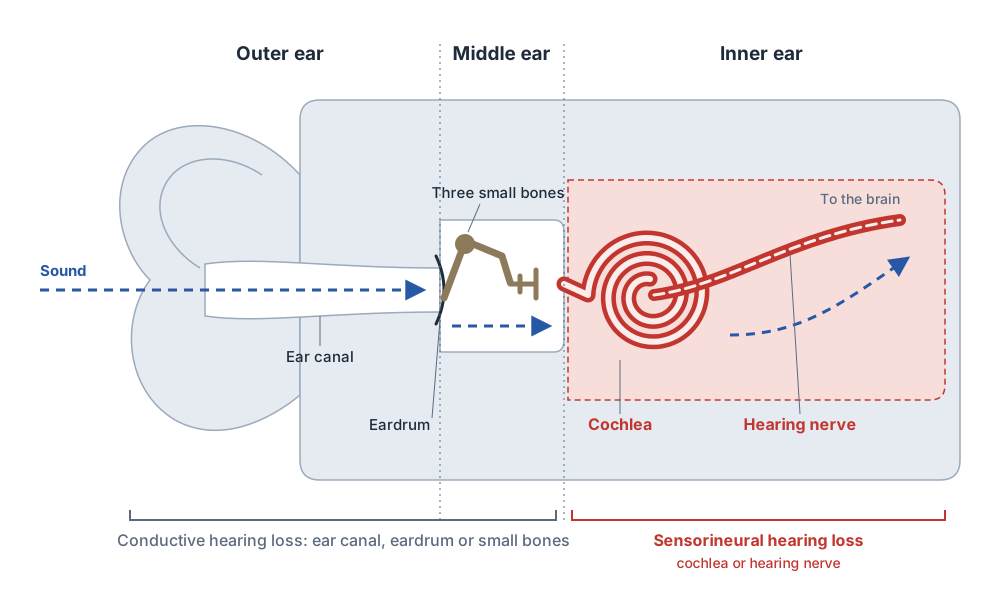
With SSD, one ear has a severe-to-profound hearing loss, and the other ear hears normally or close to it. The loss is usually sensorineural, meaning the damage is in the inner ear (the cochlea) or the hearing nerve, not in the ear canal or middle ear. That's why a regular hearing aid in the deaf ear usually doesn't help: making sound louder is no use if the ear can no longer turn it into a signal the brain can use. This would be like shouting into a microphone that's broken or unplugged.
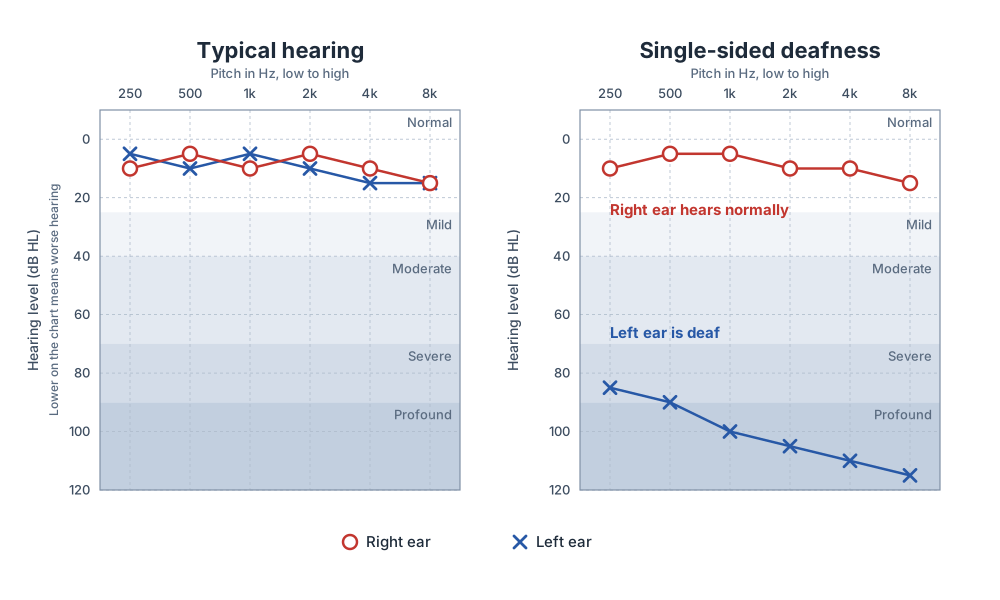
Hearing is measured in decibels hearing level (dB HL). The number is the softest level at which you can just hear a tone, so lower is better. 0 dB HL is the softest sound an average young person with healthy ears can hear, and anything up to about 25 dB HL counts as normal. For comparison, a whisper is about 30 dB. Severe hearing loss starts at about 70 dB HL, roughly as loud as a vacuum cleaner, and profound loss at about 90 dB HL, as loud as a lawnmower.
Specialists define SSD as hearing at 70 dB HL or worse in the poorer ear and 30 dB HL or better in the other ear 1.
You may also come across the term unilateral hearing loss, which covers any degree of hearing loss in one ear. Single-sided deafness is its most severe form.
What causes single-sided deafness
Often, no definite cause is found. When one is, it depends partly on when the hearing loss started.
Causes in adults
- Sudden sensorineural hearing loss. This is the most common cause of SSD that develops later in life 2. Hearing drops over a few hours to three days, usually for no clear reason 3.
- Acoustic neuroma (vestibular schwannoma). A slow-growing, noncancerous tumor on the balance nerve, which runs alongside the hearing nerve. It usually causes gradual hearing loss in one ear, often with ringing, and doctors check for it whenever one ear hears much worse than the other 3. Acoustic Neuroma and Hearing Loss in One Ear covers it in more detail.
- Other causes. Ménière's disease, head injuries, infections such as meningitis or mumps, and surgery near the inner ear can all leave one ear deaf.
Causes in children
- Congenital cytomegalovirus (CMV). When this common virus passes from mother to baby during pregnancy, it is the leading non-genetic cause of sensorineural hearing loss. The loss can appear after birth and get worse over time, sometimes in the better ear too 4.
- Cochlear nerve deficiency and inner ear malformations. The hearing nerve or the inner ear on one side didn't form fully before birth.
Because a child with one good ear often seems to hear fine at home, SSD may only come to light at school.
Symptoms: what SSD feels like
The basic symptom is simple: little or no sound from one side. But its effects in daily life are often subtler than people expect.
- Trouble hearing people on your deaf side. You may find yourself turning your head or switching seats without thinking about it.
- Difficulty in noise. A quiet one-to-one chat may be easy, while restaurants, parties, meetings and car rides are hard.
- Trouble telling where sounds come from. Finding a ringing phone, spotting who is talking in a group, or working out where traffic is coming from all get harder.
- Tinnitus. Ringing, buzzing or hissing in the deaf ear is common.
- Tiredness. Following conversations takes more effort with one ear, and many people feel drained after social events.
- Dizziness or balance problems. These can occur when the cause, such as sudden hearing loss, Ménière's disease or an acoustic neuroma, also affects the balance organ next to the cochlea.
Why noise and direction are so hard with one ear is explained in Hearing With One Ear in Noisy Places.
When SSD comes on suddenly, the first sign may be a blocked or full feeling in the ear, loud ringing, or dizziness. It's easy to blame earwax or a cold. A doctor can tell the difference between a blockage in the outer or middle ear and a problem in the inner ear, and that check is the first step in the guidelines for sudden hearing loss 3.
How single-sided deafness is diagnosed
Diagnosis usually involves an ENT doctor (otolaryngologist) and an audiologist. The doctor asks about your symptoms and looks into your ear to rule out earwax, infection or fluid.
The main tests are:
- Pure-tone audiometry. You listen for tones through headphones and through a small headband that sends sound through the bone. This shows how much you hear at each pitch and whether the loss is in the inner ear, and it gives the averages used in the SSD definition 1.
- Masking. While your deaf ear is tested, you'll hear a rushing noise in your good ear. It stops the good ear from picking up tones meant for the deaf ear, which would make the deaf ear look better than it is.
- Speech tests. You repeat words, in quiet and sometimes in noise, to show how well you understand speech.
- Imaging. An MRI scan checks for an acoustic neuroma or other causes behind the cochlea. If MRI isn't possible, an auditory brainstem response (ABR) test can be used instead 3. In children, a scan also shows whether the hearing nerve and inner ear have formed normally.
For babies, testing for congenital CMV is most reliable in the first two to three weeks of life, using a urine or saliva sample 4.
After the diagnosis
A diagnosis of single-sided deafness opens up options. CROS hearing aids, bone-anchored systems and cochlear implants are all designed for SSD, and each works differently. CROS vs. Bone-Anchored vs. Cochlear Implant: Choosing an SSD Option compares them side by side. Simple everyday strategies, such as choosing where you sit, also make a real difference, and Living With Single-Sided Deafness covers these.
Finally, look after your good ear. You now rely on it for everything, so protect it from loud noise and keep up regular hearing checks.
Sources
-
Van de Heyning P, Távora-Vieira D, Mertens G, Van Rompaey V, Rajan GP, Müller J, et al. Towards a unified testing framework for single-sided deafness studies: a consensus paper. Audiol Neurootol. 2016;21(6):391–398. doi:10.1159/000455058
-
Usami SI, Kitoh R, Moteki H, Nishio SY, Kitano T, Kobayashi M, et al. Etiology of single-sided deafness and asymmetrical hearing loss. Acta Otolaryngol. 2017;137(sup565):S2–S7. doi:10.1080/00016489.2017.1300321
-
Chandrasekhar SS, Tsai Do BS, Schwartz SR, Bontempo LJ, Faucett EA, Finestone SA, et al. Clinical practice guideline: sudden hearing loss (update). Otolaryngol Head Neck Surg. 2019;161(1_suppl):S1–S45. doi:10.1177/0194599819859885
-
Aldè M, Binda S, Primache V, Pellegrinelli L, Pariani E, Pregliasco F, et al. Congenital cytomegalovirus and hearing loss: the state of the art. J Clin Med. 2023;12(13):4465. doi:10.3390/jcm12134465