CROS and BiCROS Hearing Aids Explained
Published
How CROS and BiCROS aids route sound from the deaf side to the hearing ear, and who benefits.
Someone calls your name from your deaf side, and you don't notice. At dinner, the friend on that side seems to mumble, no matter how many times they repeat themselves. In the car, the passenger seat might as well be soundproof. If you have single-sided deafness (SSD), these moments are probably familiar.
A CROS hearing aid is built for exactly this problem. It catches sound on your deaf side and sends it to the ear that still hears. It's the oldest treatment for SSD, and the main one that doesn't involve surgery 1. This article explains how CROS and its cousin BiCROS work, what they can and can't do, and how to find out whether one suits you.
What CROS and BiCROS mean
CROS stands for Contralateral Routing Of Signal. "Contralateral" means "on the opposite side": the system takes sound from one side of your head and delivers it to the other.
A CROS system has two parts, and each looks much like an ordinary hearing aid:
- A transmitter on your deaf ear. It holds a microphone that picks up sound on that side. It doesn't play any sound into the deaf ear itself.
- A receiver on your hearing ear. It plays the sound from the deaf side into your hearing ear, mixed with the sound that ear already picks up naturally.
Early systems joined the two parts with a wire, sometimes run through a headband or the frame of a pair of glasses. Today's systems send the sound wirelessly 1.
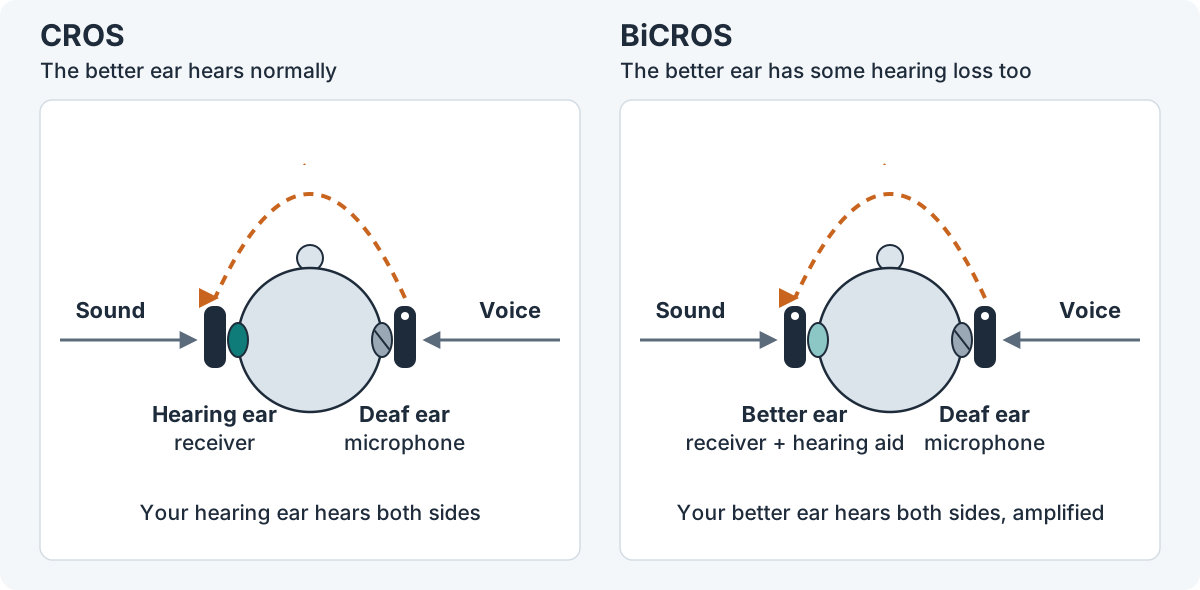
BiCROS (bilateral CROS) is for people whose better ear isn't perfect either. Here the device on the better ear is a full hearing aid. It amplifies sound on its own side to make up for that ear's hearing loss, and it also plays the sound sent from the deaf side. Your audiologist chooses between the two based on your hearing test: if your better ear hears normally, CROS; if it would benefit from a hearing aid of its own, BiCROS.
| CROS | BiCROS | |
|---|---|---|
| Better ear | Normal or near-normal hearing | Has some hearing loss of its own |
| Device on the deaf ear | Microphone and transmitter | Microphone and transmitter |
| Device on the better ear | Plays sound from the deaf side | Plays sound from the deaf side and amplifies sound on its own side |
| Surgery | None | None |
Both CROS and BiCROS are really two flavors of the same idea: pick up sound on the deaf side and send it to the better ear.
What a CROS aid can do
The main job of a CROS aid is to beat the head shadow. Your head blocks sound, especially high-pitched sounds such as the consonants s, f, t and th. So a voice on your deaf side reaches your hearing ear weaker and more muffled, and those consonants carry much of the meaning in speech. A CROS microphone picks up the voice before your head gets in the way. Hearing With One Ear in Noisy Places explains the head shadow effect in more detail.
Research backs this up. A review of 27 studies looked at devices that send sound from the deaf side to the better ear. Besides CROS aids, these include bone-anchored systems, which carry the sound through the skull instead of through the air. When speech came from the deaf side, these devices improved understanding of speech in noise by about 2.5 decibels on average, and people reported fewer hearing difficulties in daily life 2. A study of CROS and BiCROS aids alone found the same kind of benefit when speech came from the deaf side 3.
Two and a half decibels may not sound like much, but in a noisy room even a small gain can make a voice easier to follow. In everyday terms, people often notice the benefit most in situations like these:
- A passenger talking to you in the car, when they sit on your deaf side.
- A colleague at the next desk, or someone walking beside you on your deaf side.
- Meetings and meals where you can't choose your seat.
- Noticing that someone has started talking to you from your deaf side at all.
What a CROS aid can't do
It doesn't restore two-ear hearing
With a CROS aid, everything still ends up in one ear. Your brain still gets just one signal, so it can't compare the two ears the way it normally would. The two-ear advantages that depend on that comparison, such as binaural squelch and summation, don't come back 1. How Your Ears Pull Voices Out of Noise explains what these are. Of the main options for SSD, only a cochlear implant gives the deaf ear its own input again 4.
It doesn't help you find where sounds come from
Telling where a sound comes from relies on comparing your two ears, so a CROS aid can't restore it. Studies have found no improvement in sound localization with CROS 1, and in one study people's localization was actually worse with a CROS or BiCROS aid than without one 3. With sound from both sides arriving in the same ear, a voice on your left and a voice on your right can seem to come from the same place.
It can bring noise across, too
A CROS microphone can't tell a voice from a clattering kitchen. When the noise is on your deaf side, your head would normally shield your hearing ear from it. A CROS aid sends that noise straight across, and that can make speech in noise harder to understand 1. In the same review of 27 studies, people did about 3.1 decibels worse on average when the noise came from the deaf side than they did without a device 2. That loss is bigger than the 2.5-decibel gain when the voice is on the deaf side, so it pays to know when to turn the CROS side down.
Using a CROS aid in noisy places
Without a CROS aid, the usual advice is to keep noise on your deaf side and let your head block it. With a CROS aid switched on, that trick works less well, because the microphone picks up the noise and sends it over. Here is what helps:
- Know how to turn the CROS side down. Depending on the model, you may be able to lower the volume of the deaf-side microphone, mute it, or switch to a program for noisy places. Ask your audiologist to set this up and show you how.
- Think about where the noise is. If the people you want to hear are on your deaf side and the noise is elsewhere, leave the CROS side on. If the noise is on your deaf side, turning the CROS side down may help more.
- Keep using your other tactics. Good seating, good lighting and telling people which side to talk to all still help. Living With Single-Sided Deafness covers these in detail.
Who CROS and BiCROS suit
A CROS or BiCROS aid may be worth considering if:
- One ear has little or no usable hearing, and a regular hearing aid can't help it.
- You'd rather avoid surgery, or surgery isn't a good option for you.
- You want to find out how much it helps to hear sound from your deaf side before considering a surgical option.
There are trade-offs, too. You wear a device on both ears, including your good one, and some people find an earpiece in their only hearing ear uncomfortable or feel it blocks natural sound. An open fitting, which leaves the ear canal partly open, can reduce this. There are also batteries to charge, and costs and insurance coverage vary.
Not everyone sticks with a CROS aid. In some studies, many people decided against one after trying it, often because the benefit felt too small for the hassle 1. That's not a reason to skip a trial, but it is a good reason to try one in your own daily life before you buy.
Trying a CROS aid
Because there's no surgery involved, a CROS or BiCROS aid is easy to try. A typical path looks like this:
- Hearing tests. An audiologist checks both ears, ideally including how well you understand speech in noise, not just in a quiet booth.
- A trial period. Ask for a trial of several weeks, and use the aid in the situations you find hardest, such as restaurants, meetings and the car.
- Fine-tuning. Go back with notes on what worked and what didn't. Volume, programs and the fit of the earpiece can all be adjusted.
Questions worth asking your audiologist:
- Do I need CROS or BiCROS, based on my better ear?
- How long is the trial, and what happens if it doesn't work out for me?
- Can I turn the deaf-side microphone down or off myself?
- Is it rechargeable, and can it stream phone calls?
- Would a bone-anchored system or a cochlear implant be an option for me?
CROS aids are one of three main options for SSD. Bone-Anchored Hearing Systems for SSD and Cochlear Implants for Single-Sided Deafness are the other two, and CROS vs. Bone-Anchored vs. Cochlear Implant: Choosing an SSD Option compares all three side by side.
Quiz
Sources
-
Snapp H. Nonsurgical management of single-sided deafness: contralateral routing of signal. J Neurol Surg B Skull Base. 2019;80(2):132–138. doi:10.1055/s-0039-1677687
-
Kitterick PT, Smith SN, Lucas L. Hearing instruments for unilateral severe-to-profound sensorineural hearing loss in adults: a systematic review and meta-analysis. Ear Hear. 2016;37(5):495–507. doi:10.1097/AUD.0000000000000313
-
Choi JE, Ma SM, Park H, Cho YS, Hong SH, Moon IJ. A comparison between wireless CROS/BiCROS and soft-band BAHA for patients with unilateral hearing loss. PLoS One. 2019;14(2):e0212503. doi:10.1371/journal.pone.0212503
-
Pantaleo A, Murri A, Cavallaro G, Pontillo V, Auricchio D, Quaranta N. Single-sided deafness and hearing rehabilitation modalities: contralateral routing of signal devices, bone conduction devices, and cochlear implants. Brain Sci. 2024;14(1):99. doi:10.3390/brainsci14010099